
Innovating Leadership:
Co-Creating Our Future
Hosted by Maureen Metcalf
Conversations with global thought leaders on leadership, culture, and innovation—designed for executives navigating complexity and building resilient organizations.
The Strength of Vulnerability
Episode Description
Vulnerability has become a leadership buzzword, but Jacob Morgan argues that openness without competence is just an excuse for poor performance. Through his Vulnerable Leader Equation, he shows how the strongest leaders pair emotional honesty with decisive action, contrasting a CEO who admitted struggles yet offered no direction with one who acknowledged uncertainty while projecting a clear vision. Drawing on his own family’s immigrant journey and his experience with panic attacks, Morgan makes a persuasive case that connection and capability are not opposites but partners.
Key Takeaways
- Effective vulnerability means intentionally taking emotional risk while still moving toward a positive outcome.
- A leader’s words carry organizational weight, so their openness differs from vulnerability in everyday life.
- Admitting struggle without offering direction leaves teams anxious rather than inspired.
- The best leaders combine honesty about uncertainty with a confident vision for how the team will respond.
- Vulnerability should never become a justification for poor performance; competence and connection must travel together.
Why This Episode Matters
It gives executives a disciplined way to be authentic and human without sacrificing the clarity and confidence their teams depend on.
Featuring
Episode Topics
Podcast Air Date
Episode Duration
Watch the episode
Episode Content:
The Vulnerable Leader Equation
Jacob Morgan, author of Leading with Vulnerability: Unlock Your Greatest Superpower to Transform Yourself, Your Team, and Your Organization shares this article as a companion to his podcast The Strength of Vulnerability.
My parents relocated to the United States from The Republic of Georgia, which was a part of the former U.S.S.R. They both fled at the same time because they didn’t feel safe or free, but they didn’t actually meet until they both arrived in Italy. My grandmother actually introduced the two of them! From Italy, they ended up in Australia and then in America.
My dad was obsessed with the “American Dream.” He changed his last name to “Morgan” to sound more American because nobody was able to pronounce his real last name, Mamisashvili, over company loudspeakers.
He moved to the United States first to set up a life before my mom and I joined him from Australia. For several years my mom and dad communicated with each other by sending letters in the mail. He learned to speak English by watching the Johnny Carson and Merv Griffin shows with an English-to-Russian translation dictionary. He would spend hours each day looking in the mirror and trying to mouth out English words properly while he lived in low-income housing in New Jersey.
He just retired from the corporate world after working for decades as an aerospace engineer, where he commuted an hour and a half to and from work each day (during Covid he worked from home). My dad still sometimes makes the commute just to play soccer with some of his co-workers; he’s 73. My mom is one of the top marriage and family therapists in Los Angeles, and they live 15 minutes away from me.
When you’re surviving like my family was, there is no room for weakness. You have to be strong and tough. My mom has always been more open and encouraging of vulnerability and emotion, but ultimately I grew up watching and emulating my dad, who doesn’t believe in a trophy for a second place. I remember one time, after a soccer tournament, my dad and I drove to the coach’s house to pick something up. I must have been around ten years old. We knocked on the coach’s door, and he handed me and my dad a trophy. My dad looked at the coach and said, “What is this trophy for, they came in last place?” The coach said that they were giving participation trophies so kids wouldn’t feel left out. My dad chuckled and said, “That’s bull****; you can keep the trophy,” and we got in the car and left. This was an important life lesson for me, and it taught me the importance and value of hard work, life doesn’t give participation trophies and it doesn’t care about your problems.
My dad always told me that the world is a jungle and that as a man you always need to be strong and highly competent. Never show weakness under any circumstance, nobody cares about your problems so don’t share them, and always be good at what you do, or more specifically, try to be the best at what you do.
That’s how I lived my entire adult life until a few years ago when I had a series of panic attacks.
Like you, I had heard of vulnerability and had an idea of what it was, but was it really that simple? I felt like most of what I was reading and seeing made it sound like if you just share your weaknesses and challenges then your problems will go away. Perhaps that’s a decent solution in your personal life but what about at work which has a completely different dynamic? At work you have hierarchy, employees, customers, deadlines, a boss, and the issue of money. And what if you’re a leader who is actually responsible for the lives of other people and the fiscal side of a business?
After interviewing more than 100 CEOs and conducting a survey of 14,000 employees in partnership with DDI, it became clear that vulnerability for leaders is not the same as it is for everyone else.
On August 20, 1991 Hollis Harris, then CEO of the struggling Continental Airlines, sent out a memo to his 42,000 employees. He acknowledged that the company was facing challenges and didn’t share that he had a way forward to turn things around. He ended the memo by telling his people that the best thing they could do was pray for the future of the company.
That was vulnerable, but where was the leadership?
If Hollis was a junior employee who worked in accounting, then those statements would have had minimal impact. Some employees may have taken notice, maybe some would have taken him out to lunch to ask him why he’s having a bad day, and he would have received some words of encouragement and support from his leader and life would have moved on. When you’re a leader the things you say and do carry more weight and have more impact.
Another such leader is Fleetwood Grobler, the President & CEO, Sasol Limited, a South African energy and chemical company with over 28,000 employees. When he took over as CEO the company was $13 billion in debt and was about to be taken over by the banks. He too had to address his employees but his message was different. He acknowledged the challenges of the business and admitted that he didn’t know the exact path forward. But, he said he has a vision of what the business can become and he believed in the talent of the people who worked there. He said that together they can rebuild trust amongst their customers and employees and if they work together to come up with a plan to achieve his vision, that they would be able to turn the business around…and that’s exactly what they did.
Fleetwood was vulnerable, but he added leadership.
A vulnerable leader is a leader who intentionally opens themselves up to the potential of emotional harm while taking action (when possible) to create a positive outcome.
To be a vulnerable leader you need two things, vulnerability and leadership. I call this The Vulnerable Leader Equation:
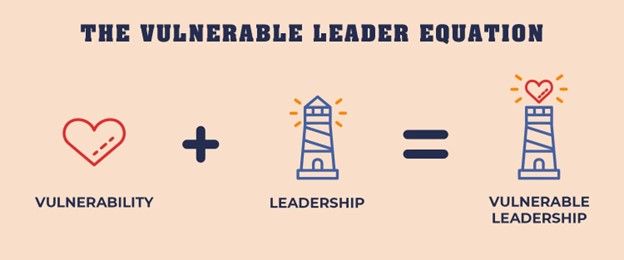
Too often we use vulnerability as a way to justify poor performance but the best leaders are able to bring together both competence and connection…leadership and vulnerability.
If you want to learn how to do that then check out my new book, Leading with Vulnerability: Unlock Your Greatest Superpower to Transform Yourself, Your Team, and Your Organization.
Resources:
Jacob’s book on vulnerability is Leading with Vulnerability (hardback = https://amzn.to/46Eueyt and Kindle = https://amzn.to/3ZEbZqw). His earlier book is The Future Leader (hardback = https://amzn.to/46Euxt7 and Kindle = https://amzn.to/3PJzlpY).
The new book’s website is http://www.LeadingWithVulnerability.com, and his main website is https://thefutureorganization.com.
Our host, Maureen Metcalf, posts a newsletter every week on LinkedIn. You can subscribe here.
She’s also written several award-winning books on leadership development. You can peruse and purchase them here.
Books we’re reading for fun or personal development right now include:
- The Five Lost Superpowers: Why We Lost Them & Hot to Get Them Back by John Reid, et al
- The Parable of the Sower by Octavia Butler
- The Left Hand of Darkness by Ursula K. LeGuin
- Snow White & the Seven Robots by Louise Simonson & Jimena Sanchez
Other episodes you’ll enjoy
- Getting Positive Results from Hard Conversations with Dr. Marcia Reynolds
- When Women Lead: Courage, Change, and Representation with Congresswoman Joyce Beatty
- Bridging Research & Practice: The Medical Model You Can Use with Dr. William Smoyer
Guest(s):
Guest(s) Bio:
After graduating with honors in business management economics and psychology from the University of California Santa Cruz, Jacob was excited to join the corporate world. At his first job he was told that he’d be traveling the country, meeting with executives and entrepreneurs, and doing all sorts of exciting work. A few months in, he was stuck doing data entry, cold calling, and PowerPoint presentations. One day the CEO came out of his nice corner office, handed Jacob a $10 bill and said, “I’m late for a meeting, go grab me a cup of coffee, and get something for yourself as well.” That was the last corporate job he ever had.
Today, Jacob Morgan is a trained futurist and one of the world’s leading authorities on leadership, the future of work, and employee experience. He speaks in front of tens of thousands of people each year and his content is seen over a million times a year. Jacob is the best-selling author of five books: Leading With Vulnerability (Wiley, 2024), The Future Leader (Wiley, 2020) The Employee Experience Advantage (Wiley, 2017), The Future of Work (Wiley, 2014), and The Collaborative Organization (McGraw Hill, 2012). He speaks at over 50 conferences a year including TED Academy which is one of the largest TED events in the world. In addition, Jacob provides advisory and thought leadership services to various organizations around the world.
Want to be a guest on the Innovating Leadership Podcast?
Want to sponsor the Innovating Leadership Podcast?

Our Podcast Team:

Maureen Metcalf
Podcast Host

Dan Mushalko
Editor & Producer

Jenna Reik
Podcast Manager
Love the show?
Leave us a review and rating:


Transcript
(auto-generated)
Transcript