

July 11, 2014
Defining Your Vision

I’m Eric Philippou, and I’m writing this blog as part of my summer internship at ILI, a leadership and management consulting firm. I am entering my final fall semester at The Ohio State University, majoring in Strategic Communication. I like marketing and plan to attend business school in a few years. I’m also on the varsity fencing team at Ohio State.
If you’re a college student, you may often think about what you want to do with your life. Even after lots of soul-searching, many of you are still uncertain about what you want to do. This summer, I am starting a blog that helps students find their life purposes, plus a step-by-step guide on bringing this vision into reality. I am giving you information from a workbook written by a combination of college faculty and leadership development and executive coaching experts who make business executives very successful. This book will be published late in 2014. I am working with the draft version to create a blog series. Throughout this blog, I will provide my answers to the exercises as an example.
Here are the six steps to conquering your dreams, all of which I am covering this summer:

Define Your Personal Vision
Step 1: Create a picture of your future. Imagine yourself in the future, at the end of your life, happily reflecting on your success and how you achieved it. Answer these questions:
- What is the thing of which you are most proud?
- Motivating millions with my non-profit organization (NPO).
- If you had a family, what would they say about you?
- They would say that I would do anything for them, and I was selfless and great to them.
- What did you accomplish professionally?
- Climbed to the top of a large corporation and started a highly successful NPO.
- What would your friends say about you?
- The funniest guy they knew, always great to hang out with, and I’m an overall great guy.
Step 2: Write a story. Now that you have a general idea of what you will do, write a short story that goes into further detail about these things. Include details about your answers from above, and consider the questions below. This will act as a roadmap for your journey and what you would want if designing the perfect life for yourself.
- Who helped you along the way?
- My wife, family, and friends – many of whom I met in business.
- What did you enjoy about your daily life?
- I always ate well because I am a great cook. I also had a lot of fun interacting with co-workers, clients, and my family.
- Who was closest to you?
- My wife, family, and a few friends are people I have known for a long time.
- What feelings did you have as you accomplished each milestone along the way?
- Overwhelming joy and pride and each accomplishment motivated me to tackle the next milestone. I am also proud that on the days I felt concern, and even a bit of fear, I kept focused on my goals and moved forward.
- How did you mentor and contribute to the success of others?
- At work, I mentored my co-workers who worked below me and brought out the best in them. In my NPO, I touched millions with my work and helped many people worldwide succeed.
- What did you do to maintain your health?
- I exercised often to keep my energy up, ate nutritiously, and relaxed to recharge my batteries.
- What role did spirituality or religion play in your journey?
- Not a large role. I always stuck with the golden rule unconditionally.
- What job(s) did you have?
- From entry-level to executive at a large corporation and then founder of my NPO.
- What role did material success play in your life?
- I won’t lie, I did enjoy making a lot of money. Money gave my family and me opportunities that we wouldn’t otherwise have. Material success played a decent role in my life but was not the main goal.
- What type of person were you? (Kind, caring, driven, gracious, etc.)
- I was always regarded as very generous, selfless, and driven.
Step 3: Describe your vision. Now that you have more information about yourself and how you want to live create a two-to-five-sentence life purpose statement. This talks about your highest priorities in life and your aspirations. This statement should capture the essence of how you want to live and project yourself.
- An example: My vision is to bring maximum greatness to myself and the rest of the world. I will conduct myself with integrity and always push myself, knowing that succeeding in my goals will benefit the human race. I will live the best and happiest life that I could imagine. The world will benefit from me being here long after I am gone.
Step 4: Expand and clarify your vision. Many of you probably have a mixture of selfless and self-centered elements to your vision. You may wonder if wanting wealth and luxury in your vision is okay. For now, suspend your judgment about what is “worth” desiring and instead ask yourself which elements of these visions are closest to your deepest desire. Ask yourself, “If I could have it right now, would I take it?” and consider what about each element appeals to you.
- For example, in my answer, my true deepest desire is to impact the world positively. I want to be wealthy, but right now, if I did that to the extent I desire, I could die and be 100% content with my entire life. In your life purpose statement, focus more on what would bring you complete peace with yourself. Consider this, and revise your life purpose statement accordingly.
- Some elements of your vision will not surpass this question, and others may only pass under specific circumstances. Some may change over time.
- My previous life purpose statement looked like this: I will climb up to top management in a large organization. I will have enough money to have an awesome house and luxury cars and even create my nonprofit organization that focuses on providing people with motivation and success strategies. Everyone who meets me will think, “Wow, what a great guy.” I will show respect for everyone.
- Then I asked, “If I could have it right now, would I take it?”
- Climbing to top management of a large corporation
- Yes, but only if the corporation does things that I support and I get to where I am ethically. It’s more about having the power and resources to carry out what I believe will benefit society more.
- Enough money for an awesome house and luxury cars
- Yes, but only if I received it ethically and it brings me the joy I seek.
- Enough money to start a nonprofit organization
- Yes.
- Everyone who meets me will be impressed.
- If I’m impressed with myself, and I feel my accomplishments have benefitted humanity, then the desire to impress others is not very important – merely a bonus.
- I will show respect to everyone.
- Yes, that is a very broad goal I can easily control immediately.
- Climbing to top management of a large corporation
- After thorough analysis, I refined my life purpose statement according to the previous step: My vision is to bring maximum greatness to myself and the rest of the world. I will conduct myself with integrity and always push myself, knowing that succeeding in my goals will benefit the human race. I will live the best and happiest life that I could imagine. The world will benefit from me being here long after I am gone.
June 16, 2014
I am entering my final semester at The Ohio State University in the fall, majoring in Strategic Communication. I like marketing, and I plan to go to business school in a few years. I’m also on the varsity fencing team at Ohio State.
This summer, I am starting a blog that helps students find their life purposes, plus a step-by-step guide on how to bring this vision into reality. The information I am giving you is from a workbook written by a combination of college faculty and leadership development and executive coaching experts who make business executives very successful. This book will be published late in 2014. In this post, you will find your personal values. Throughout this blog, I will provide my own answers to the exercises as an example.
This is part two of the three-part Vision topic. My answers are in italics.
Checklist for personal values
Step 1: Define what you value most. Values shape the way we think, feel, and act in our daily lives. To effectively achieve your life goals, they must match your values. From this list, select your top ten most important values to live your perfect life.
List of Personal Values:

My top 10: integrity, love, expertise, excellence, meaningful work, creativity, freedom, influencing others, self-respect, order
Step 2: Elimination. Now, from your top ten, narrow your list down to your top five values. Now narrow it down to your top three.
- Top 5: integrity, love, excellence, meaningful work, influencing others
- Top 3: love, excellence, meaningful work
Step 3: Integration. From your top three values, ask yourself:
- How would your life be different if those values were prominent and practiced more?
- I would probably have better results in school, work, and personal relationships. If practiced earlier, like in high school, I may be at a different university or even a different area of study.
- What does each value mean, exactly? What do you expect from yourself, even in difficult times?
- Love: care for the people around me, especially for the people close to me. In difficult times, I would think of those closest to me and perhaps look to them for help or motivation.
- Excellence: overall skill, expertise, brilliance, and high-quality performance. I expect myself to always pursue excellence in everything I do, especially in difficult times when it is needed the most.
- Meaningful Work: the work I do excites me, and I look forward to going to work and doing it every day. In difficult times, I would like my work to be meaningful, and something I love to do, because it will push me to keep going and give me less incentive to quit.
- Does the personal vision you outlined reflect those values?
- Yes, as far as I can tell.
- If not, should your personal vision be modified?
- If not, should you reconsider your values?
- If not, should your personal vision be modified?
- Are you willing to create a life in which these values are paramount, and help an organization put those values into action?
- Now that I see how it could benefit me, yes. The things holding me back from doing so seem less important, and almost silly, so I have no reason not to go forward with such a life.
Real-World Application
So you’ve narrowed down your values and determined how to integrate them into your life. Try something out: write down your top three values and tape them somewhere so that you see it a lot, and strictly live by those values every hour of every day for the next few days. After a few days, monitor any differences in your usual days and the last few days of acting on your values. I tried this, and I found myself to be more productive in my work, more vibrant during personal interactions, and overall very happy. Hopefully, you’ll get similar results, and if you do, you know you picked the right values to live by.
June 17, 2024
Defining Vision-Based Actions for College Students
In this post, you will find your values. Throughout this blog, I will provide my answers to the exercises as an example. This is part three of the four-part Vision topic. My answers are in italics.
In this post, I’ll show you how to set a realistic career direction based on your vision. We discussed creating your vision and identifying your values in the last two posts. In the next post, I will answer some great reflection questions. It turns out reflection is a key part of this process.

Putting Vision into Action
Now that your vision is outlined, it’s important to put it into action. Consider your values and vision, as well as your skills. In this exercise, you will find ways to incorporate your passions into how you make a living. Also, think of ideas or topics that you find extremely interesting and are somehow involved in almost everything you do – school, work, social activities, entertainment media, etc.
Step 1: Identify your foundation.
- What are you most passionate about?
- Values: love, excellence, meaningful work
- Respect
- Order or being organized
- Creativity
- Doing things the right way and not cutting corners
- Doing the right thing in general
- Success/winning
- I would be lying to myself if I didn’t put “food” on this list
- Deep thinking
- What are your economic needs, and what can you do to meet them?
- Overall financial stability: enough to not be worried in case of some family emergency, such as one of my family members needing surgery.
- I want to create sufficient funding for the NPO.
- Somewhere between a modest upper-middle class lifestyle and the guy from ‘The Wolf of Wall Street.
- Business strategy
- Marketing/sales
- Project management
- Public speaking
- What can you be great at?
- Marketing/sales
- Business strategy
- Project management
- Friend
- Philanthropy/non-profit work
- Teamwork
- Public speaking
Step 2: Review and Identify Overlap.
- Creativity and deep thinking are involved in all of the professional skills that I can be great at (my creativity led me to try marketing and strategy initially)
- Excellence and success in my professional field(s) can create wealth
- Doing the right thing and love overlap with philanthropy
- Having a lot of money of my own can help fund my NPO
- Meaningful work and philanthropy
- Business strategy
- Marketing/sales
- Project management
- Public speaking
Step 3: Harvest the ideas.
- Based on overlaps, do you see anything that can be incorporated into what you do or how you work?
- My passions for creativity, excellence, deep thought, and success, combined with economic needs/wants, tell me that I should pursue a career that involves marketing, business strategy, and/or project management.
- I should work in companies and projects that I find meaningful, ethical, and beneficial to others.
Look at your answers carefully and consider as many ideas and overlaps as possible. Even if something you think is useless, writing it down anyway is good.
June19, 2024
Reflecting on Personal Vision
Reflection Questions
After each of the six steps in the innovative leadership development process, I’ll provide some helpful reflection questions. If you can answer all of these questions in detail, you’ll develop a firm understanding of your vision, and your action plan can be implemented almost immediately. The “What do I think/believe?” section refers to your intentions, and the “What do I do?” section refers to your actual behavior. The “What do we believe?” section refers to your group’s intentions, and the “How do we do this?” section refers to your group’s actions and processes. Think of any organized group you belong to (student club, sports team, fantasy football league) and use that to answer the last two sections I mentioned. If you’re not in an organized group, join one and save those reflection questions for after you’ve joined. Remember – even as a new group member and not a leader, you can still display leadership by influencing change. In my answers, the organization I refer to is my varsity fencing team.


This marks the end of the first step in becoming an innovative leader as a college student. The next post will analyze your strengths and situation in step two. I’ll provide you with some personal assessments to take, this way you get a firm understanding of your personality type, special skills, how you can work best in a group setting, and much more.
**Photo credit: OSU Athletics, Ohio State University
June 25, 2014
Assessing your Strengths
Now that you’ve created a compelling future vision, it is time to move to the next step in becoming an innovative leader and successful college student – analyzing your situation and strengths.
In this section, you will take several assessments to identify what you do well and where you can improve. As you discover your strengths and weaknesses, you must focus 80% of your effort on maximizing your strengths and 20% on improving your weaknesses.
By combining your vision with an understanding of current abilities, performance, and personality type, you will become more aware of strengths, weaknesses, and how others see you. The assessment data should help you determine the space between your current state and your vision. Some of them will require you to spend money,

Assessment Tools
You will use a combination of assessment tools to get a broad range of knowledge about how you and others see you. You will assess your personality type, developmental perspective, resilience, competency, and organizational vibrancy. All of these assessments are scientifically designed and validated. I’ve taken all of these and can assure you they are helpful.
Personality Type: Enneagram
Once you understand your personality type, it will be easier to take the other assessments. For this, we recommend the Enneagram assessment. Their website has a free assessment version, but I used the $10 version for maximum results.
- My top personality type was Type 9 – the Peacemaker: easy-going, receptive, reassuring, agreeable, and complacent. I scored a 24 for this type.
- I also scored 20 for both the Achiever and Individualist types.
Resilience: ILI’s Assessment Tool
Resilience is a highly underestimated factor in becoming successful. Mental toughness is what prevents you from quitting. Metcalf & Associates developed an assessment tool to help determine and increase your resilience. It considers physical, mental, emotional, and interpersonal behaviors. It is free, and you can find it by clicking here.
- My Physical, Mental, Emotional, and Interpersonal scores were 28/35, 42/50, 36/40 and 33/35.
Competency Assessment: Clifton StrengthsFinder
Further identifying your strengths is important for becoming successful. The Clifton StrengthsFinder assesses your top five “themes” and puts them into four domains of leadership strength (executing, influencing, relationship building, and strategic thinking). You must purchase the Strengths-Based Leadership book to get the access code to take the assessment. The assessment provides an in-depth analysis of your top five “themes”, or strengths. I received pages and pages of information about how to work with my strengths effectively.
- My top five themes are Strategic, Achiever, Competition, Learner, and Focus.
Organizational Vibrancy: ISC Experience of Relational Abundance Survey
Vibrancy refers to the positive feelings associated with places we love to go, conversations we love to have, and people whose presence we enjoy. This assessment will allow you to describe your vibrancy in any group or organization you choose. It looks at both the organizations in which you work and your preferences. Click here to access the free vibrancy assessment. By identifying how vibrant your group is, you see where you are strong and where you can improve. For my survey, I chose the Ohio State varsity fencing team, which I am a member of.
- After the assessment, my experience of this group was described as “an experience of your own fullest potential, being seen and supported by another, in a group that collaborates, where the source of creativity is everywhere, and you can translate what you imagine into reality.” It says that our group can accomplish any task in our field. “You might ask yourself and the group, ‘is this the best we can do?’”
- The assessment provided me with much more detailed advice about how my group can improve.
This marks the end of my assessment scores. In the next post, I will synthesize all of these scores using an analysis tool called a Strengths, Weaknesses, Opportunities, and Threats (SWOT) analysis. This tool will help me put all of the scores together and begin to figure out how to use this information.
June 26, 2014
Analyze Strengths and Weaknesses
I recently completed a series of assessments and will now analyze the information. Gather what you’ve learned about yourself into the Strengths, Weaknesses, Opportunities, and Threats (SWOT) analysis tool. This is a great tool that you can use at any time for many different situations. You can use it in the context of your career plans and some athletes I know use it for their sports also.

Real World Application
It helps to take several different assessments to give me different views of myself. I recommend taking all of the assessments, especially those that are free. After screen capturing or printing the results, please read them carefully to see how to apply them to your daily life. Remember to put 80% of your focus on strengths and 20% on weaknesses. Perhaps take some time Monday through Thursday to focus on a different strength each day, and on Friday, focus on a weakness. For example, I’ll play to my group’s strengths on Monday based on the vibrancy assessment. On Tuesday, I’ll focus on using my “Peacemaker” abilities from the Enneagram. On Friday, I’ll focus on mitigating the weaknesses and threats from my SWOT assessment. Do that, and you may become more comfortable as a leader.
In the next post, I will answer the reflection questions about what I learned during the assessments and SWOT analysis.
July 9, 2014
Reflecting On Strengths & Weaknesses
I recently completed a series of assessments and the Strengths, Weaknesses, Opportunities, and Threats (SWOT) analysis. As usual, I like to finish each topic with some reflection questions. The “What do I believe” quadrant represents intentions, and “What do I do” represents actual behaviors. The “what do we believe” section refers to what our student organization, community, or major/department believes. The “How do we do this” section refers to the systems or processes of that organization, community, group, etc. In my answers, I am using the context of a competitive student organization, in which I am an emerging leader among students, and there are hired professionals at top management.
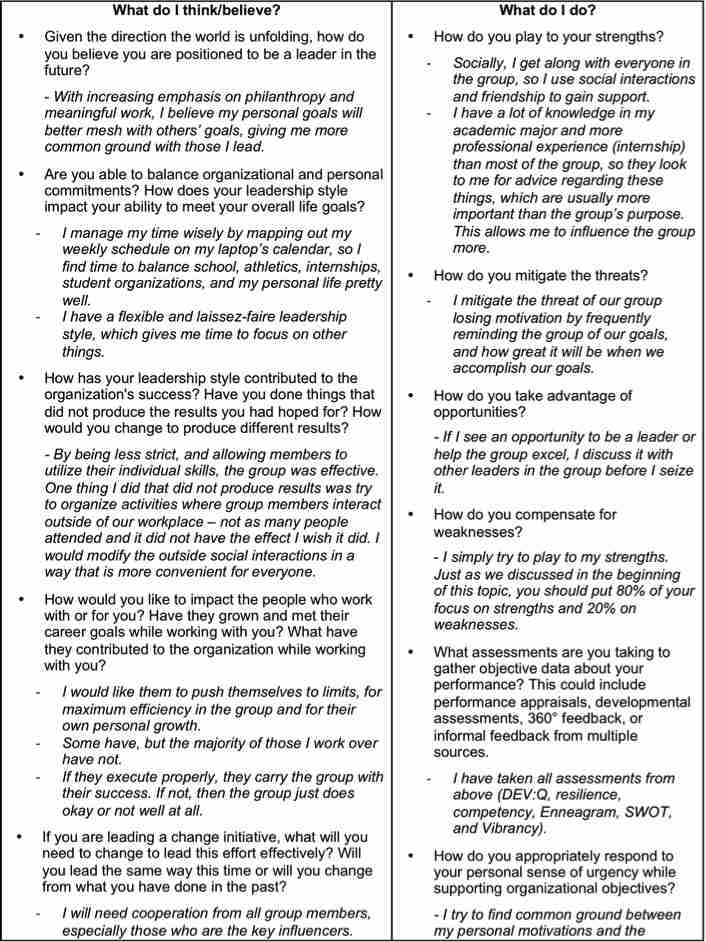
Next week, we will cover the third step in becoming successful as a college student and leader – planning your journey. Do as many of the assessments as you can so you have a full understanding of yourself, your strengths, and your situation while planning your journey.
July 16, 2014
Plan Your Career Development Journey
It is now time to move to plan our journeys understanding that our overall life goals will be achieved by accomplishing many short-term goals. This is the third step in becoming an innovative leader while you’re young.

Short-term goals may consist of milestones that move you closer to your overall achievement, such as internships, degrees, jobs, or promotions. Other short-term goals, which are equally important, consist of personal development, such as learning new skills/behaviors, building on current strengths, and minimizing weaknesses. The goals of personal development are very important because as you make progress through your academic and professional careers, you’ll have greater responsibilities and bigger challenges. That being said, to plan the short-term steps that will lead you to the long-term life goal, we must identify which career milestones we will need to get us there, and then choose which personal development goals to accomplish to help us reach the nearest milestone. For each milestone in your life, you may need to create new personal development goals. To optimize personal development (for short-term and long-term), one must include in his plan all four parts of the human experience: physical, mental, emotional, and spiritual/purpose.
Short-term Goals: Career Milestones
As you’ve done for previous posts, research and list the steps it takes to get that “dream job”, or long-term goal. Then identify the nearest goal. For example:
- My Goal: Marketing/management consultant and founder of a nonprofit
- My Milestones:
- Do marketing/consulting internships
- Graduate with a relevant degree and great GPA
- Get a marketing/consulting job upon graduation
- Go to graduate school for an MBA
- Get a great job in marketing/consulting
- After sufficient experience, create a highly successful nonprofit organization
- Nearest goal: Job upon graduation
Short-term Goals: Personal Development
Look at your nearest goal, and think of everything you can possibly learn, strengthen and/or fix to achieve the nearest milestone. This will help you find which personal development goals to set to reach the next milestone. The human experience consists four parts: physical, mental, emotional and spiritual/purpose abilities. Enhancing all four of these types of abilities, you will optimize overall personal growth. We separate these four parts into two categories:
- External abilities (physical and mental):
- Body: exercise, weight lifting, yoga, relaxation, etc.
- Mind: reading, studying, attending school/class, etc.
- Professional skills, learned at school, work, internships, etc.; relevant to your career.
- Internal abilities (emotional and spiritual/purpose) –
- Emotional Quotient (EQ): meditation, maintaining strong friendships/relationships, etc.
- Spirit/purpose: define vision, define values, religious practice, etc.
- Includes intention, world view, purpose, vision, values, cultural norms, emotional stability, resilience, a sense of being grounded, overall personal well-being, intuition, balanced perspective, and attitude, and serves as the foundation for you to accomplish your deepest aspirations.
According to Ken Wilber, a leading philosopher, one can optimize improvement in one of these areas by “cross training”, or working on an external skill at the same time as an internal skill. For example, people who lift weights (external) and meditate (internal) tend to have more success in both areas than those who only do one or the other.
Planning Personal Development Goals
Choose amongst three developmental focuses: learning a brand new skill/behavior, building on a current strength, or minimizing a weakness. After you pick something to develop in one of those three focus areas, identify whether it is an internal or external ability, and then pick an activity that is the opposite ability for the sake of optimization by cross training. Click here to download the worksheet below (which doesn’t have my answers on it) and fill it out like I did. Feel free to view my answers to maybe better understand the question, or just to get more ideas.

Over the next few days, choose a skill and think about how great your life can be if you gain/improve it. In the next post, we’ll make a day-to-day plan for developing that skill to help you reach your next career milestone.
July 18, 2014
Plan Your Career Development Journey Part 2
In the last post, we discussed identifying a skill/behavior that you would like to improve to help you reach your next career milestone, with the understanding that our long-term life goals comprise a series of short-term goals. In this post, you’ll identify the skill/behavior you’d like to improve upon and then create a plan outlining the current state of that skill, future goal, daily routine/actions, deadline for completion, and a way to measure progress.
Your goal should be S.M.A.R.T.
We recommend that your goal be specific, measurable, attainable, realistic, and timely (S.M.A.R.T.).
For example, I want to increase my focus/productivity by 200%, independently, each month during internship/work hours because I can get twice as much work done and be better prepared for entering the workforce upon graduation.
Specific: clearly defined. When goals are specific or clearly defined, it is easier to know when they are reached. Specify the goal by clarifying what is expected, why it is important, who is involved, and where it will happen.
Measurable: establish criteria for measuring the progress of each goal. This shows what and how much change we are expecting.
- Focus/productivity will be measured in how many tasks I accomplish during work hours each day. Let’s say I complete two big tasks each day; I will eventually focus on limiting distractions/overthinking to complete four big tasks each day.
Attainable: identify the most important goals to you, and you begin to find ways to make them come true. You develop attitudes, abilities, and financial capacity to reach them. You begin to see opportunities you otherwise may not see as you realize the importance of such goals. “Attainable”, in this case, refers to how reasonable the goal is overall, regardless of your ability to do it.
- Doubling daily productivity or reducing time to accomplish each task in one month is attainable for many people in my situation. Many interns can do that as they develop knowledge and skills.
- Attainable: identify the most important goals to you, and you begin to find ways to make them come true. You develop attitudes, abilities, and financial capacity to reach them. You begin to see opportunities you otherwise may not see as you realize the importance of such goals. “Attainable”, in this case, refers to how reasonable the goal is overall, regardless of your ability to do it.
- Doubling daily productivity or reducing time to accomplish each task in one month is attainable for many people in my situation. Many interns can do that as they develop knowledge and skills.
Realistic: to be realistic, the goal has to be something you are personally willing and able to work toward. You are the one who determines when it is completed, so make sure it is something you can realistically accomplish. “Realistic”, in this case, differs from “attainable” because it specifies whether you can accomplish the goal. There may be something unique about you, making you better/worse at accomplishing a task than most people in your situation. If it is too easy, increase the difficulty or tighten the deadline. If too hard, decrease difficulty or push back the deadline, but only after you’ve tried it for a bit – don’t give up too easily!
- Doubling daily productivity is realistic because I am increasing my knowledge and skill of my work at a higher rate than I could have ever anticipated.
Timely: goals that lack time frames also lack urgency. When setting the time frame, set an actual number or defined time, like “one month” or “one school year”. Don’t just say “soon”, “ASAP”, or “eventually”. Would you rather your professors tell you, “You have an exam soon!” or “You have your exam one week from today?
- “One month from today” is a defined time.
Ensure your goal is written down in a way that meets the S.M.A.R.T. criteria. Next, we will use the Development Planning Worksheet. This chart should be simple enough to make in Microsoft Excel or Google Spreadsheet. Follow my lead:

I highly recommend using a digital calendar with cloud capabilities and managing time well. This link will help you manage your time during the academic semester: http://howtostudyincollege.com/time/. While the link specifies making time for studying, it is still a great time management strategy and will help you find time for your goals.
Now you have a great sense of your short-term goals and your strategy to reach them, plus some potentially life-altering time management advice! In the next post, you will be provided reflection questions regarding the entire journey planning process. After that, you should have a very firm understanding of how to plan your journey as an innovative leader and outstanding college student.
July 23, 2014
Plan Your Career Development Journey Reflection Questions
In my last post, we analyzed in-depth our short-term goals to help reach our next career milestones and discovered effective time management techniques. Now, we will fine-tune our short-term goals by answering specific reflection questions. In accordance with the nature of innovative leadership, we not only consider how our personal development goals impact ourselves, but we also consider how they impact our organizations.

We have reached the end of the Plan Your Journey step. This is the third of the six processes of developing innovative leadership – you’re halfway there! As you can see in the graphic below, the next topic is Build Your Team & Communicate, in which we will create a group of mentors and partners to help us before we go all-out in the Take Action step.
August 8, 2014
Take Action to Develop as a Leader
I’m Eric Philippou, writing this blog during my college internship at ILI. In this post, we will take the next step in the innovative leadership development process: taking action. This post will discuss how to start effectively and mitigate any potential barriers.
Start Effectively
First, you must believe you can accomplish your short-term milestones. If you’ve been closely following the previous posts and participating in the exercises, and you’re serious about chasing your life goals, then you are more than capable of accomplishing these short-term milestones. You may seem intimidated and overwhelmed, but that’s what you want. If you’re not exiting your comfort zone, you’re not growing.

Secondly, this process will not only take you out of your comfort zone but will require some consistent commitment. If you must, do not start out too extreme. Take it slow in the beginning, familiarize yourself with the routine, and gradually push yourself to greater limits.
Overcoming Barriers
Most importantly, you’ll need to allow yourself some flexibility in your plan because you will likely face obstacles that may require you to modify your routine temporarily. Below is a worksheet to help you overcome your barriers. Feel free to refer to my answers to see how to answer each space. The goal I’m referring to is how I want to increase my productivity with work.
| Barrier Action Planning Worksheet | ||||
| Category | Barrier | Impact of Barrier | How to Remove or Work Around | Support I Need to Remove or Work Around This Barrier |
| In my thinking | I over-analyze small details, which take me on tangents about unrelated things. | It distracts me, removing my focus from the actual task, and I think about something completely irrelevant. | Maintain perspective on the overall goal of certain tasks to better understand the functions behind the smaller details, requiring less thought later on. | Personal support to hold me accountable each day. |
| In my behavior | I try to multi-task way too much. | This impedes my productivity. | Focus on one task at a time, do it right the first time, and practice “essentialism.” | Personal support, casually reminding each other about essentialism. |
| In our beliefs | We depend on third parties to do their part of a task too often. | This slows us down because we wait for them to finish. | Rely less on external sources’ work and consider doing their part by ourselves. | Professional partnership support to find out what we can do without a third party. |
| In how we do things | We multi-task as a group. | It impedes productivity. | We are reminding each other to focus fully on the tasks at hand. | Remember that I must also focus and ask others to do the same. |
Real-World Application: Create a Barrier Log
Review your responses for the Barrier Action Planning Worksheet and create a spreadsheet document. Label the first column “Barrier”. Move one column to the right, and label the next five columns, from left to right, “Attempt #1”, “Attempt #2”, and so on. In the column labeled “Attempt #1”, write how you plan to overcome the corresponding barrier, perhaps using the response you put for the Barrier Action Planning Worksheet. If you fail on the first attempt, write a new or refined way to overcome that barrier, plus what you did wrong in the previous attempt in the Attempt #2 section, and continue this process until you eventually overcome the barrier. On the attempt where you finally succeed, highlight that box in green. As new barriers rise, add them to the log; however, after you complete a barrier, it is critical that you keep it on the log and do not delete it.
This barrier log will be useful because you can track what did and did not work to overcome a barrier. You will likely come across barriers similar to previous ones, so knowing what worked (and what didn’t) in advance makes the barrier easy to overcome. As time passes, and you begin to see a long list of old barriers with green boxes, signifying success, your confidence in overcoming barriers will increase. It may be grueling to add more attempts because you keep failing but understand that only true failure is failure to try.
Feel free to include barriers outside the leadership development process, such as academic, social, and even health barriers. Save this document in a cloud storage service for both safety and convenience. Update it regularly. Also, if one of your mentors from the Build Your Team section is an “equal” or someone in the same situation as you, have that person make a barrier log and share logs with each other online or during meetings.
In the next post, we will answer reflection questions to strengthen our understanding of how we’ll take action.
Photo Credit: www.flickr.com Celestine Chua
August 13, 2014
Take Action to Develop as a Leader, Reflection Questions

In this post, we will answer reflection questions so that we are thoroughly prepared to take action. As always, feel free to refer to my personal answers in italics to get a better sense of what we’re asking. I am answering these reflection questions to clarify my thoughts about my plan to overcome barriers and leverage enablers from my prior post.

This post contained the first half of the reflection questions for taking action. In the next post, I will complete the reflection questions.
photo credit: www.flickr.com Celestine Chua
August 15, 2014
Take Action to Develop as a Leader, Reflection Questions Part 2
In this post, I will answer the second set of reflection questions involved with prepared to take action. As always, feel free to refer to my personal answers in italics to get a better sense of what we’re asking. I am answering these reflection questions to clarify my thoughts about my plan to overcome barriers and leverage enablers from my prior post.

This marks the end of the Take Action part of the innovative leadership development process. In the next post, we will learn how to embed innovation systematically and maintain the mindset of an innovative leader throughout your life.
August 20, 2014
Embed Innovation Systematically

Congratulations! We have arrived at the final step in innovative leadership development. In this post, we will begin creating a Personal Transformation Log. With this, we will know how to track our actual behaviors toward our goals, measure progress, and compare them to expected behaviors and progress. As always, my responses are in italics, which you can use to strengthen your understanding of the question. The next part of this post will give you real-world application suggestions.
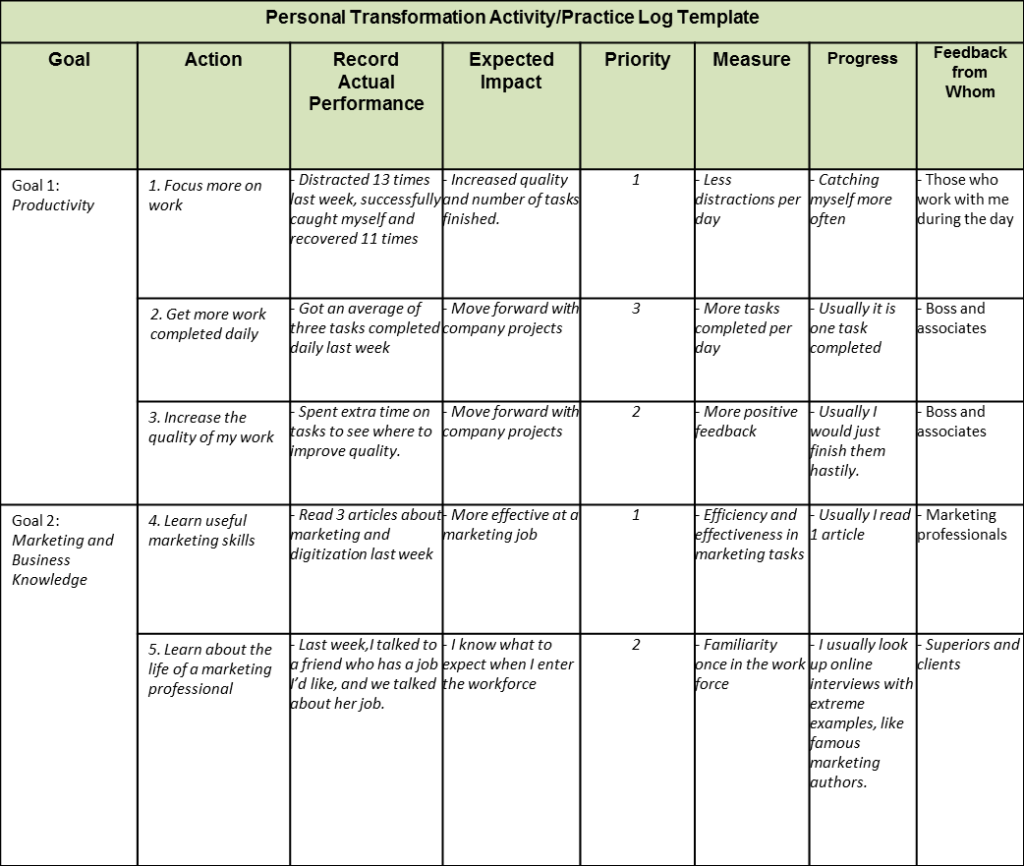
Real World Application: Expect the Unexpected & Fail Fast
While it’s important to focus on what’s in front of you in the present, it’s also important to consider the future. As you progress on your current goals and you’re in a good rhythm, take a few moments occasionally to consider what goals you could set. Consider upcoming events, such as job hunting or graduate school programs. What kind of skills and behaviors would you like to develop by then? Another important thing is to take unpredictable events into account.
One thing guaranteed is that some completely unexpected and uncontrollable events will happen in your life, which could greatly impact your short- and long-term goals. Due to this, it may be worth considering strengthening your resilience and problem-solving skills/behaviors when setting goals in the future.
Remember, failure is natural, and no one is perfect. View mistakes and failure as an opportunity to learn. After all, the only true failure is failure to try. Remember to think like a scientist and use experiments or constant trial-and-error. We like to use the term “fail fast”, meaning the faster you figure out what does not work, the faster you can determine what does.
In the next post, we will answer reflection questions to systematically strengthen your understanding of embedding innovation.
Photo credit: www.flickr.com Celestine Chua
August 22, 2014
Embed Innovation Systematically Reflection Questions Part 2
Congratulations! We have arrived at the final step in innovative leadership development. In this post, we will cover reflection questions part 1 to strengthen your understanding of embedding innovation systematically into your lifestyle. My answers are in italics for you to use as a reference to further understand the questions.


There will only be one more post for college students in the innovative leadership development series! In the next post, we will review the second half of the reflection questions.
Photo credit: www.flickr.com Celestine Chua
August 27, 2024
Embed Innovation Systematically Part 3, Reflection Questions
We have arrived at the final step in innovative leadership development. In this post, we will cover the second set of reflection questions to strengthen your understanding of embedding innovation systematically into your lifestyle. My answers are in italics for you to use as a reference to further understand the questions.


Congratulations! This has been the final post for college students in the innovative leadership development series! Remember, innovative leadership and personal development are lifestyles. Once you have developed one skill/behavior to an ideal capacity, you must continue to focus on more areas to develop to strengthen your arsenal of skills as a person. Feel free to revisit my posts or purchase the Innovative Leadership Workbook for College Students. Good luck!
Photo credit: www.flickr.com Celestine Chua