
Innovating Leadership:
Co-Creating Our Future
Hosted by Maureen Metcalf
Conversations with global thought leaders on leadership, culture, and innovation—designed for executives navigating complexity and building resilient organizations.
Lasting Solutions for Distribution Center Labor Shortages
Episode Description
Will O’Brien and Dave DuBose examine the structural drivers behind persistent labor shortages in distribution centers, highlighting how e-commerce growth, workforce expectations, and competitive hiring dynamics are reshaping supply chain operations. They argue that short-term fixes such as wage increases fail to address underlying system inefficiencies and workforce design challenges. The discussion outlines a more durable approach that combines operational redesign, employer differentiation, and workforce optimization to sustain performance.
Key Takeaways
- Labor shortages in supply chains are structural and unlikely to resolve through market cycles alone
- Wage increases and incentives provide only temporary relief without addressing root causes
- Redesigning work processes can reduce labor dependency and improve operational efficiency
- Employer differentiation is critical to attracting and retaining a reliable workforce
- Workforce strategy must balance productivity, reliability, and long-term sustainability
Why This Episode Matters
For senior leaders, this perspective reframes labor shortages as a systemic business challenge requiring strategic redesign rather than incremental HR solutions.
Featuring
Episode Topics
Podcast Air Date
Episode Duration
Watch the episode
Episode Content:
People, People Everywhere and Not A Person To Hire…
 This blog is provided by Dave DuBose and Will O’Brien from True North Growth Partners, as a companion to their interview on Innovating Leadership, Co-Creating Our Future. This interview, Lasting Solutions for Distribution Center Labor Shortages, aired on 9/10/19.
Of course, that title is a takeoff from Coleridge’s “The Rime of the Ancient Mariner”. The author referred to a thirsty sailor surrounded by saltwater that he cannot drink. This is what many distribution center (DC) operators face when they can’t attract and retain the workforce that they need to support their operations. With historically low unemployment, the demand for DC labor is escalating- a trend that will continue. This drives higher wages while the quality of the available workforce drops.
Other factors make this situation more complex. Job candidates may be unable to meet an organization’s hiring requirements for drug testing and work history. Lowering standards creates workforce reliability issues. Ecommerce is a big driver. Amazon (the biggest example) has over 100 fulfillment & sortation centers. The e-comm channel requires 4X the labor compared to retail and wholesale fulfillment. This creates a salary war, undercutting any loyalty that workers might have had. This is magnified at peak season.
How does a leader deal with all of this? Three strategies underpin a winning playbook:
- Reduce the Work Content
- Be a “Sticky Employer”
- Get the Most Out of Your Workforce
Strategy #1, “Reduce the Work Content,” is the focus of this blog.
REDUCE THE WORK CONTENT OF THE FACILITY
Reducing work content is a challenge that belongs in the playbook. Analytical rigor is required to appropriately consider each option for achieving this goal and careful planning and execution is a must-have: these are not “quick fix” alternatives, but they can be very effective.
- DC Bypass is the method of flowing goods to the customer or store while bypassing the DC or fulfillment center. It is necessary to analyze volume and order history so that an effective program can be designed that will provide the relief to the facility and have minimal-to-no impact on supplier charges or the customer experience.
- Store-Based Fulfillment is growing rapidly. The most common version of this is BOPIS (Buy Online – Pickup In-Store). Walmart will ship an e-comm item to a store at no charge. Many grocers offer the increasingly popular curbside pick-up service. Others enable their stores to ship e-comm orders to customers’ homes. One retailer performs this function early in the morning, before the store opens for walk-in traffic. DSW stated that its stores are within 20 minutes of 70% of their customers, so they can’t afford to NOT take advantage of that proximity for improved speed and delivery cost. Target, Dick’s, Best Buy and others use store-based fulfillment as an economical way to compete against Amazon’s hyper-fast delivery model. Details related to how a retailer handles allocation, store operations, order management and small package carrier relationships are critically important. Creating and communicating a detailed plan ensures that leaders understand the assumptions about inventory, handling and transportation costs, as well as reductions in markdowns – and are committed to execution.
- Pop-Up Fulfillment Centers are used during peak seasons to provide relief from surges in demand. Advancements in robotics enable operators to slot more items in pop-ups than ever before, with reduced training needs and improved speed and customer service. Robots, in this case, Automated Mobile Robots (AMRs) from companies like Locus, Fetch Robotics and 6 Rivers can be deployed very quickly, typically in less than a day. The software that operates AMRs is cloud based, which eases the IT requirements. AMRs are safe around people and other mobile equipment. The interface between the worker and the AMR is very simple, so training for the associate takes only minutes. Worker productivity dramatically increases because the robot eliminates the need for the worker to walk the entire facility. Most AMR providers offer their products on a “Robot-As-A-Service” basis, avoiding the large capital outlay that is needed for traditional material handling equipment. There is great flexibility with AMRs as the number of machines can flex over time with volume.
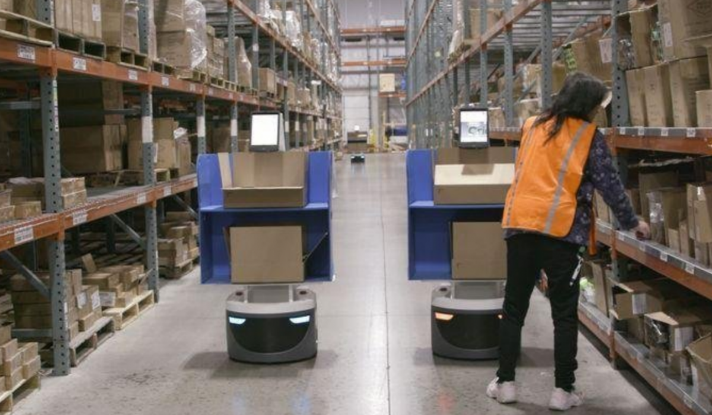
AMRs in work environment
The two most significant advantages of pop-ups are reductions in labor and the cost of the last mile. By locating pop-up facilities in markets with dense demand, the operator shifts its labor burden from hiring hundreds of associates in a labor-constrained single market to hiring dozens of associates in each of a handful of locations across the country- a much more achievable task. The cost of the last mile is significant and is reduced by having pop-ups in dense markets. Given the success of pop-up DCs, operators are beginning to consider keeping them open year-round to augment distribution networks that need e-comm friendly solutions for speed, cost effectiveness and customer service. Careful product flow analysis and cost modeling ensures that the solution will deliver the intended benefits.
- Automated Material Handling Equipment (MHE) solutions offer different options for reducing labor requirements in large, capital-intensive DCs. Continued innovation in automated-storage-and-retrieval and goods-to-person systems, as well as in conveyors, sorters and put-walls, enable operators to realize significant labor savings. 60% of a DC worker’s time can be spent walking in the facility, sometimes as much as 15 miles per day. Innovative developments continue in pack station and auto-bagger technologies. Automated MHE solutions fit well in high-volume operations and these solutions require significant effort to properly design and select the appropriate equipment for each situation.
- Leverage a 3PL Partner: Finally, sophisticated 3PLs provide a wide range of services, from end-to-end fulfillment, including last mile delivery, to executing only the pieces of an operation that are most challenging to the business. A 3PL is a viable option for many scenarios. It is very important to perform due diligence in partner selection and in the integration of all processes and technologies to guarantee a flawless conversion and smooth operation.
If you are facing distribution or fulfillment challenges in your business, there are many options available to you. If you would like to discuss your situation with Will O’Brien or Dave DuBose, they can be reached at www.truenorthgrowthpartners.com.
Resources:
Will and Dave are partners with True North Growth Partners; you can learn more at https://truenorthgrowthpartners.com. (We love their motto: “If you don’t know where you’re going, any road will get you there.”)
Our host, Maureen Metcalf, posts a newsletter every week on LinkedIn. You can subscribe here.
She’s also written several award-winning books on leadership development. You can peruse and purchase them here.
Books we’re reading for fun or personal development right now include:
- Hello, I Must Be Going: The Mostly True Story of an Imaginary Band by David Meyers
- The Parable of the Sower by Octavia Butler
- The Left Hand of Darkness by Ursula K. LeGuin
- Snow White & the Seven Robots by Louise Simonson & Jimena Sanchez
Other episodes you’ll enjoy:
- Forget Power: How to Lead in a World of Chaos & Complexity with Michelle Harrison
- How Great Leaders Are Made: Insights from The Economist’s “Boss Class” – with Andrew Palmer
- To Stop a Tyrant: The Power of Followers with Ira Chaleff
Guest(s):
Guest(s) Bio:
Will O’Brien is a partner at True North Growth Partners where he works with organizations on the supply chain and operations sides of their business. He helps his clients overcome the things that hold back their growth and profitability. He has over 30 years of experience in supply chain and operations. He has held executive positions in both industry and consulting. As an executive at Lowe’s Home Improvement he helped to lead the development of the supply chain for that big box retailer during a period of rapid growth, from $35 billion to $50 billion in revenue. He also helped pioneer Lowe’s omni-channel fulfillment when its online sales were growing significantly. He successfully grew a mid-sized family-owned supply chain consulting firm by over 50%, expanded its markets, improved its pricing, reengineered its sales and business development organization and created career paths and professional growth for its associates.
Dave DuBose is a senior supply chain professional with strong cross-industry experience including retail, consumer products, resources and high-tech in the North American and global theaters. Dave has held executive positions in logistics and supply chain in industry as well as consulting and has more than 30 years of professional experience. DuBose delivers innovative results and can translate business strategy into operating strategy and tactics. He has deep expertise in end-to-end business operations and in deploying business solutions from strategy through implementation. Dave is on the Columbus Roundtable, and the Council of Supply Chain Management Professionals. He is active in speaking and writing about contemporary supply chain issues.
Want to be a guest on the Innovating Leadership Podcast?
Want to sponsor the Innovating Leadership Podcast?

Our Podcast Team:

Maureen Metcalf
Podcast Host

Dan Mushalko
Editor & Producer

Jenna Reik
Podcast Manager
Love the show?
Leave us a review and rating:


Transcript
(auto-generated)
Maureen 0:08
Maureen, hi, I’m Maureen Metcalf, CEO of the Innovative Leadership Institute. I appreciate your interest in this show’s topic. It’s an archive edition on our Innovating Leadership podcast. This interview is a few years old. We have since evolved as an organization, and in our podcasts, we renamed the company from Metcalf and Associates to the Innovative Leadership Institute, and significantly improved our audio quality. What’s consistent over time is our guests’ wisdom. It’s timeless and worthwhile. Stay tuned, and enjoy to Today we’re going to talk about lasting solutions for distribution center labor shortages, and our guests are Will O’Brien and Dave DeBose. Will is a partner at True North Growth Partners, where he works with organizations on supply chain and operations side of their businesses. Dave Dubose is a senior supply chain professional with a strong cross-industry experience, including retail, consumer products, resources, and high tech in North America and global theaters. So, between the three of us, we have 90 years of experience. Let us hope we’re smart. So, today we’re going to talk about labor shortage and the fact that it’s not going away.
Speaker 1 1:26
Thank you for having us. Thanks. Great to be here, Maureen.
Maureen 1:28
Let’s start with the labor shortage for DC centers. How significant is the labor shortage, and how many people work in a typical DC?
Speaker 2 1:37
It’s very significant. Dave just looked quickly at the Google machine, as I call it, and Columbus, where we are today, is at about 3% unemployment, and I think functional full employment is for between four and 5% If you look at some government numbers, there are over 700,000 jobs that are open in excess of applicants for those jobs,
Maureen 2:03
so what happens if I run an organization? We just don’t have enough people, do I not ship stuff? Do people work longer hours? What do we do? Yes, and yes,
Speaker 2 2:14
and to some extent, you’re, you’re a little too late, but that doesn’t keep an organization from scrambling. So they’re going to be working on wage increases, they’re going to be working on giving bonuses to stay or to sign on. There’s going to be overtime, and that’s where the leadership is really stressed in terms of how good of leaders they are, because a lot of times that ends up being taken out on the people. Right,
Maureen 2:34
I remember working for a client, and it was the hourly workers in a manufacturing facility, and they had issues of people sneaking out of their shifts to pick up their kids from daycare, right, things like that, because they were, they had compulsory overtime, and you’re choosing between your job and your kids,
Speaker 2 2:53
correct,
Maureen 2:53
and those are pretty untenable choices.
Speaker 3 2:56
So, the earth is shaking when that happens, and there are a lot of retailers that lose sales. Yeah, and we’re in Columbus, so we’ll just cited the statistic about 3% unemployment, so we’re in a tight situation. If you live here, you realize this is a distribution hub, one of the great distribution hubs for the United States, and in particular, we have a number of different industries, but in particular, we have a lot of retail here. Specialty retail, in particular, tends to have a severe spike at holidays, something like three or 4x to one. So, it’s in fact, my old employer, one of the sayings was, a day is a week and a week is a month, so when you’re talking about the volume compression that hits the wave rather than hits starting, yes, around Thanksgiving. It actually starts more like november 1. Now things have kind of moved back in terms of the calendar, and it extends through, you know, January, basically. So it’s a, it’s a, and, and the companies that are out there are very, very well aware of this. They’re all competing for the same resources. We’ll talk some more about that, but they basically have a plan to go out and just acquire those temporary and seasonal resources, because they know they’re going to have this enormous spike.
Maureen 4:15
Now, because our audience is global, I don’t want to focus entirely on Columbus. I’m assuming distribution is a global issue because the components used to manufacture everything we use come from around the world.
Speaker 3 4:29
Absolutely, your
Maureen 4:30
shirt probably has buttons from one country, thread from another country, fabric from a third country, and they may actually stitch it someplace else,
Speaker 2 4:39
correct? And China is becoming more expensive, even as a manufacturing point, because there’s so much demand coming out of there, getting, getting a middle class, or becoming more expensive, as China gets more expensive, a lot of that production starts moving to Indonesia and other markets, right?
Maureen 4:52
So this really is a global issue, not just a Columbus. Absolutely, Columbus is
Speaker 2 4:57
an example of the distribution. Deviction side of things, if you will, but if you look at the overall supply chain, it is very integrated. It is definitely global, and there’s definitely a ripple effect that goes all the way around the world. Okay, in distribution, when we used to, and this is a North American statement, more so bear with me, but we used to consider where we’re going to put the next distribution center for a number of reasons, balancing transportation costs, but we’d always look at labor market as well, because you could be one, you could be 25 or 30 miles away and normally be neutral, you know, overall cost wise. So you look at the relative labor markets, and you used to know some markets were good labor markets than others, right? There’s not a good labor market anymore,
Maureen 5:37
specifically in the US. In
Speaker 2 5:39
the US, okay, I’m
Maureen 5:40
assuming there are other entire countries or portions of countries that have similar dynamics,
Speaker 1 5:46
correct? Okay, correct. And
Maureen 5:47
others that have relatively high unemployment, but there are other factors influencing the unemployment.
Speaker 2 5:53
And I talked to one executive, and he said, ‘Will I spent my whole career in this market that he was in? He said, ‘I’ve never had a trouble, I never had trouble getting employees last year. I had trouble, and this year I’m having worse, and that was, that was actually about two years ago that we had this conversation, and it’s just gotten worse each year since then. It’s a challenge, kind of across the board.
Maureen 6:16
So, as we go through in the third segment, we’ll talk very specifically about what people can do in this segment to kind of wrap it up. What happens to DC operators when there aren’t enough workers to fill the open roles?
Speaker 2 6:28
So think about it, I’m in a situation where I need to get three to 400 people to to fulfill my peak season, and this is a very retail centric analogy, but it’s not limited to retail, if I blow fourth quarter, which is the peak season, I’ll blow the financials for the whole year. So that’s a lot of corporate pressure coming down on you. I’m going to pay whatever to pay to get the people in here, and to the extent that I fail at that, I risk losing a lot of sales, and there are no shortage of retailers that have gone out of business because Christmas didn’t show up because they, and part of that is because they couldn’t fulfill, and if I
Maureen 7:04
have to pay whatever it costs, that eats into my margin.
Speaker 2 7:07
Now I’m selling them profitably, right? I’m also reducing the standards that I hire by, so I’m pulling people in, they can’t pass my drug test, that’s probably right around correct, right? Who’s got the backbone to stand up under that pressure I described, and to say, ‘No, I’m not going to hire this person when this person is willing to unload a truck, you know, for me. Yeah, and they
Maureen 7:29
don’t have to be completely coherent to take boxes off.
Speaker 2 7:33
I talked to an operator, this was around October or so, and he said, ‘You know, will I hired 12 forklift operators. A week later, I only had three.
Maureen 7:45
Now, those guys, you want to be sober. Yes, that’s machinery, and there is
Speaker 2 7:52
some skills necessary because you’re putting things up, you know, 20 something feet in the air, a very heavy palette of product, right? So, there’s some skill to it, and he’s having such trouble if he’s, and that’s he only kept three a week later. I don’t know what happened in weeks two or three, I mean, this three he kept, but I had to hire 12 to have three a week later, and I thought that was terrible, and I thought maybe that’s, that’s, you know, specific to him. Then I talked to somebody in another part of the country, and his answer was, well, yeah, that’s about right,
Speaker 3 8:23
yeah, and we’re, and we’re, you know, we’re laughing a little bit, because some of it is, you know, a little bit funny, but these are serious, you do have to really think about and contemplate these issues and do it in a very planful way, and it’s difficult, and when you get into, you know, there’s a danger of getting, you know, into I’ll call it the fire of peak season, and you will, you know, we’ll hit on this probably a time or two, but your options are expensive and few at that point in time, but you still have to do something, because to Will’s point, you know, you don’t want to risk missing holiday and going out of business, so it’s a, it’s
Speaker 2 9:00
a tough problem, so now year two and three, a lot of folks don’t think this is robust enough to say, yeah, we’re going to be ready, because I’ve already prepared the organization to increase wages in September again. Well, everybody, the other six buildings that you’re competing with are increasing their wages in September too, and I bet you Amazon will increase them more.
Maureen 9:20
Now, I wonder, and I am clearly not the expert, but I wonder about people moving from one industry to the next. So, say I’ve got a robust construction industry in the summer and I need people to work in my DC in the winter. Is there a transition between labor fields where I can draw from surveyors or people who are directing traffic during road work or any number of people who have some skills and either train or or they’re already trained up and they just maybe they surf in the summer and they work in a DC. In the winter,
Speaker 2 10:00
yeah, so there’s transient, you know, and there’s jobs that lend themselves to just about anybody can show up, because unloading a truck is moving a box, and so there’s other jobs that you’re interacting with the screen, and you have to be able to take instruction, you have to work at a certain pace, you have to be literate, and
Maureen 10:15
we still have people who
Speaker 2 10:17
correct,
Maureen 10:17
aren’t,
Speaker 2 10:18
or you can design your systems for that, and that’s a whole nother topic. Is there are people with mental and other challenges that you can design a lot of interfaces for that enables them to work from graphical images, and it’s in that another subject, but it’s a great workforce, great workforce, and expands,
Speaker 3 10:37
expands your employee pool too. Frankly, I mean, so really inspiration, absolutely, and
Maureen 10:42
it’s great for communities about stickiness.
Speaker 2 10:45
That’s that’s one of the things, because when you give them that, you give them some independence, you give them some well-being that they never thought, or their parents never thought that they would have. Walgreens is a pioneer of that, and those people, they just, they keep showing up, and they’re doing what they do, and they
Maureen 11:01
value the job in a way that other people may not. A
Speaker 2 11:04
lot of them, it’s about screening them into the right job, so they work at productivity levels well beyond what your typical productivity levels are.
Maureen 11:11
Oh, interesting. Okay, DSW
Speaker 3 11:13
has done a great job of that as well, too. Another data point. Yeah, sure.
Maureen 11:16
Cool. So, what are you seeing in DC? The DC operators are doing to solve this problem, and again, I understand we’re not limiting it to just DCS, but maybe the broader supply chain. So, why don’t you first let’s expand the definition and let our help our listeners understand exactly what bucket you’re talking about.
Speaker 3 11:40
Yeah, we’ve been using the term in the first segment, distribution, which is, I think, a very accurate term. I would broaden it probably a little bit more to logistics, so we’re talking about physical movement of product, and we’re focusing heavily on the distribution center and what happens in the distribution center. Some people call it a warehouse, but really it is probably a little bit broader than that, because you’ve got needs that are outside of that, up and down the supply chain, the DC, and the logistics within the DC, I think, are really kind of the critical element here, because you run into, as we discussed in the first segment, a problem with just being able to get enough of qualified people and keep them and retain them in the, in the environment,
Speaker 2 12:24
and it happens to manufacturers as well. So it’s manufacturing. Last week, my wife took a picture in the grocery store and sent it to me, because she was appalled that there is a huge display of candy for Halloween. This was middle of July with Halloween displays already out in the stores, so think about why that happens, because what happens in the store in October has to happen in the distribution centers six to eight weeks ahead of that, naps at manufacturing six to eight weeks ahead of that. So, your Halloween candy has already been produced, so it’s just time phase, but they’re all facing it, and if it’s distribute or employee intensive business, same fundamental. When we talk about material handling equipment, we’ll be pretty distribution specific,
Speaker 3 13:05
but there’s the interesting thing is you mentioned manufacturing, and the thing is things do get produced. There’s a lead time, China, or more broadly, Asia is really the world’s factory, right? Gets made over there, gets shipped over and containers on ships, typically, you know, there’s some probably law of physics, right? That stuff’s got to have some place to go, right? So it comes, you know, clear, you know, comes into the Port of Long Beach, or wherever it comes into, gets into various distribution centers across, in, you know, this case, the US, but you could expand that globally, and they’re going to get full and they’re going to ship out to stores, so you got your Halloween candy early, you know, dynamic or bathing suits, bathing suits in February, kind of thing, and then you know those stores, and you could say the same thing about online, you know, where the DC is your store, basically, but it’s got to have a place to go, right, it can’t sit there, it’s got to move, and with lead times being what they are, and manufacturing cycles being what they are, that’s what you end up with.
Maureen 14:07
Supply chain, the job, I think, is to make it as efficient as possible, and take all the cost out, which then leads us to which part do you optimize?
Speaker 3 14:20
Well, yes, I mean, so yeah, I mean, you optimize the whole thing, that’s what makes it, that’s what makes it a tough problem, yeah, exactly, and, and that’s, that’s a tough problem, and that’s basically, it’s a tough thing, and it’s a tough equation, there’s, and you know, you’ve kind of noted there’s just a lot of variables across snowstorms happen, things have you know, you’ve got an economic downturn, you got environmental factors, you got disasters, you got whatever, and it’s just, yeah, exactly, there’s a lot of things to factor in.
Maureen 14:56
So, what are some DCs doing to solve the problem? What have you seen that’s worked
Speaker 2 15:01
well before I hit what’s worked? Let me tell you what tends to be what really happens, right? So you’ve probably heard the analogy of Wayne Gretzky didn’t skate to the puck, he skated to where the puck is going to be, right? A lot of, lot of distribution and manufacturing operators, I would say, are skating to the puck in terms of, okay, they got their fingers burnt last year, so I’m going to hire earlier this year, and I’m going to set my organization up that we’re going to have higher wage increases, and I’m going to have retention bonuses for people that stay past december 25 right? Okay,
Maureen 15:34
so November 1 I start hiring, or
Speaker 2 15:37
it’s actually August now into July, moved back from September, all for
Maureen 15:43
Black Friday, or there is no Black Friday anymore. It’s all the sales start. It’s more of what I like to call you, yeah,
Speaker 3 15:48
gray November, sort of a gray November, which is what Columbus,
Maureen 15:53
Ohio, is, by the way. If you’re the
Speaker 2 15:59
only operator taking those actions, you’d be out of the game, but when all the people that you’re competing with to hire their three and 400 people for my three or 400 people for peak, when they’re all doing that, that kind of just moves the problem around a little bit, but doesn’t really solve it. So we distinguish between health and wellness and emergency care.
Maureen 16:19
Okay,
Speaker 2 16:20
if you find yourself I’m being pinched right now for employees next week, next month, or this peak, and the peak is coming on you, it may be too late in your, in your options are fewer and they’re more expensive, so you’re probably going to come to the point where you’re going to use a lot of temp agencies, you’re going to be paying a lot of money, whether it’s retention bonuses or wage increases, or meeting what Amazon’s going to pay, or whatever it’s going to be, they’re going to be, have some level of effectiveness, but as you can survive, but I think you need to aspire for more than survival, because surviving doesn’t mean when you publish to the to the street the earnings that you’ll survive at the
Maureen 17:01
still in business isn’t my aspiration, correct? I do aspire for that, but more so. So, I’ve read your work, and we’ve talked extensively about this. What else can I do?
Speaker 2 17:14
So, what our proposition is, you know, if you need help on an emergency situation, that’s one type of medicine we’re talking about, skating to where the puck is, and there’s, we, we think that there’s kind of three fundamental things that somebody can work on, and then I call this more on the health and wellness path. Okay, so that you can be prosperous in the long term, and you can have a loyal workforce that you get a lot out of,
Maureen 17:40
okay?
Speaker 2 17:40
And you can control your destiny that way. Okay, and so these are
Maureen 17:44
things like you talked about alternative workforce as one
Speaker 2 17:47
alternative workforce. You know, I kind of group them into things that reduce the work content of the DC. So, how can I support the demand that I have and do it in a way that reduces the number of people, and we’re going to talk about about equipment, material handling equipment, we’re going to talk about robotics, we’re going to talk about a few things there. Okay, the other kind of group of things that I would suggest is, and this is just my term, is be a sticky employer. There are things that an organization can do for its people if it really seeks to understand them, just like they sell to their customers, sell to your workforce, and put together a relationship if you designed it so that somebody would be crazy to ever want to leave you. Okay, and we’ll talk about some of those things in a few minutes. And then lastly is get the most out of your people.
Maureen 18:35
Okay, some
Speaker 2 18:35
of that is software technology, but a lot of that is just plain leadership.
Maureen 18:39
Okay, so some of this isn’t surprising,
Speaker 1 18:42
correct.
Maureen 18:43
It’s running your business while I’m being proactive, correct?
Speaker 2 18:46
Running a good leader.
Maureen 18:47
Okay, right. So before we leave this segment, is there anything else you want to talk about with regard to the solution being more than throwing money at it?
Speaker 3 18:57
Well, I think that it’s important to really start very, very intentionally with a focus that is, you know, months, months ahead of things, right? So, you know, if you get kind of smacked in the face and say, I’ve got to just start hiring a whole bunch of people, holy and only, this is going to be a problem. That is a way of dealing with this, not a particularly effective one, really. This is what we call poor leaders, reactive leaders. Yeah, really, what you want to do is bake this into your – the risk of using kind of warm words here – you want to bake this into your overall strategy, and so HR has got to play a really, really in your, as well as your logistics and distribution leadership, got to play critical, critical roles in doing this, because you got to really think about your workforce. What are you trying to do? You’ve got to think about your plan for inventory, and everybody has this as time goes on. And then, what is it really going to take just mathematically to meet that? And then I’ve got to think about what are my options, and really just get out ahead of it. So, a lot of it is just. Being very planful and thoughtful and executing well.
Maureen 20:04
Okay, so conceptually these are not new ideas. The tactics you’re using may be very different given the change in the ecosystem that now I go to my friend Jeff Bezos every time I want to buy something and Lowe’s doesn’t have it right or my local pet food store doesn’t have it, or it’s the middle of the night, I’m leaving for a business trip, and I realize I need something to be delivered at home that I forgot to buy.
Speaker 2 20:32
Two avenues of newness to hit at what you’re asking about. Number one is technology is available today that wasn’t available to parents, and it really changes the entire block. We’ll talk about that. The other is orchestrating a more complex, a more comprehensive view towards how do I give care and feeding to my people, so my people never want to leave.
Maureen 20:52
And in a time of less than full employment, my people didn’t want to leave at the rate that they’re leaving now. At this point you said 3% here.
Speaker 3 21:02
Yeah,
Maureen 21:03
that’s lower than structural unemployment. That’s, I’ve got to pull people out of the air, right, springing them out of jail so they can come work for me. Yeah, and hoping they can pass a drug test. Yeah, basically
Speaker 2 21:14
have a playbook, put the right plays in it, and execute the heck out of this place. Okay,
Speaker 3 21:20
so it is a combination of things, right. There were some, there were some sort of tried and true. This is not exactly rocket science, just good leadership, good planning, good strategy, and execution, right. There’s there’s that piece of it, which is, and now I think the way you do it, there’s some secret sauce to that, but yes, there’s that.
Maureen 21:35
Well, and that’s why you’ve spent 30 years learning to do correct that your high school kids can’t do it right,
Speaker 3 21:40
right, right, and then the other piece is to Will’s point, is there is technology that is available today, thank goodness, that does provide different options than we had 1020, years ago, certainly. So,
Maureen 21:55
yeah, I talked to someone from PNG yesterday, and he was talking about the way they blow up parts of their business, and one is supply chain, and the use of technology has completely upended how they think about yet they still manufacture things overseas, they still come over in boats, then they put them on trains, so some things remain constant, stuff coming from another country has to get across the ocean,
Speaker 3 22:22
right, right,
Maureen 22:24
but the technology enables very different
Speaker 3 22:27
in a very simple, yes, in a very simple model, you can think of it as sort of the plan, make, move, sell, deliver, return, and that’s a very linear set of processes, right, the change with today’s world is those really have to happen pretty much in a very overlapping, if not parallel manner, right? To be able to be effective and to work in this kind of high clock speed environment that we live in, where if I don’t have it in an hour, you know, oh my god, what am I gonna do? Yeah, exactly. An example of where
Speaker 2 23:00
fundamentally is the same, but you get under the details as different. It’s not unusual at all for an organization to have one fulfillment center in the United States, give it to FedEx, UPS, whomever, and get it out to everybody in the country, and it comes at a certain cost and a certain speed. Now they’re online, 15% of all retail purchases are made online,
Maureen 23:20
only 15%
Speaker 2 23:21
and it’s growing rapidly. Yeah, 40% of that’s coming from Amazon, and Amazon setting expectations for speed and fulfillment. They’re putting fulfillment centers virtually in every metropolitan area in the country. They’re getting increasingly close to the customers, so if I’m a brick and mortar retailer, what’s my play? My play might be use my stores as fulfillment centers, doesn’t mean every store in my chain, but if I have a store in St. Louis, does that make sense for fulfilling St. Louis online demand, right? And we’ll talk about some of these things, but fundamentally, it’s just fulfillment, it’s just picking an item, giving it to the postman, and saying it to mrs. Smith, but it can be done very, very differently.
Maureen 24:06
Well, in places like your former employer, Lowe’s, which is my most frequent shopping experience, I can now go online, click stuff, and go pick it up at the front door. Right, things like that. Now, I personally actually happen to like walking around Lowe’s, but that does increase my spend.
Speaker 1 24:23
Correct, correct. Yes, and that’s
Maureen 24:30
are there lasting solutions for a labor shortage, and so what do you suggest has to happen for an organization to effectively deal with the labor shortage in the long term not scurrying about every year and panicking,
Speaker 2 24:47
so we think about three things: reducing the labor content in a DC, and we’ll talk about that in a second. In fact, let’s talk about that now. Reducing the labor content, there can be uses. Of automation, traditional material handling equipment, and robots. 70% of a worker’s time is spent walking. It’s not unusual to find someone called a picker, someone that goes down the aisles and picks the unit or picks the case to walk 13, even 15 miles a day. When I first started hearing those numbers, I thought, there’s no way that day after day, and they do, and sure enough, yeah. On
Maureen 25:25
vacation, I walked 10 simulation terms,
Speaker 1 25:27
right?
Maureen 25:28
And I wasn’t walking eight hours a day.
Speaker 2 25:30
I didn’t think I was in that good of shape. Maybe it
Maureen 25:35
was walking well. A lot of those people are
Speaker 2 25:37
on time, they’re on time standards, you know, slow, but they’re they’re able to get it in, so that’s a place where some automation is happening. If someone is walking, okay, we can have something that we’ll talk about a minute, called AMRs or AGVs, or the type of robots that will take that goods to person. Okay, but DC bypass is something that, before we jump into inside the four walls, there are scenarios, particularly if it’s at peak, depending on who your customer or your destination is. Maybe you analyze the product flows, which is a very analytical exercise that we do all the time, and understand this vendor or this product group would be smart to just skip the DC altogether and go direct to customer, or skip the DC altogether and go direct to store, because the store, when it’s changing season, is has its greatest need for inventory of that items, if it’s a seasonal type of a thing. Something about Christmas drinks coming in, Halloween candy, right? So you can, there’s ways to do a DC bypass. Another thing is, and a lot of folks are doing this, there are certain items that they want to show online that they don’t carry in the store or in the DC. The slower moving items, they’re slower size, size 14 shoe, right? Might get passed to Under Armor or Nike or Adidas or whomever to be fulfilled, right? Because they don’t sell so much, or a strange color of a shirt, right? So that’s kind of a norm, but if you’re, if you’re again, if you’re preparing for the peak and you need to carve off some of that demand, maybe you can do analysis that would look at product categories or vendors, and you have to compare, is that vendor capable, and what’s their cost of doing that. So it is an analytical exercise, but there’s some demand that you can just carve off and not have that product flow through the DC, and that’s
Maureen 27:25
the value of working with someone like you who’s had that experience, and and go in with already a reasonable point of view, and
Speaker 2 27:33
yeah, it’s a hypothesis, and a lot of data analysis of items of orders of, you know, channels, correct? Yeah, correct,
Speaker 3 27:42
yeah. I used to work with a guy who called it, you know, that you’re trying to solve the pig through the python, which is not a great image, I know, but basically it’s, you’ve got this this slug of inventory, you know, products that are coming in, bathing suits, what have you, and they’re all different kinds of items, and it is huge. And are there ways that you can take pressure off of your system by just avoiding the DC altogether? That’s great, if you can, because that just helps get it, you know, it balances your what we call the logistics network better, and it also takes pressure off the labor situation.
Speaker 2 28:21
Those can be permanent flows, or they can just be flows during peak season or transition periods of a season.
Maureen 28:28
Okay?
Speaker 2 28:28
Right. Another is using stores – we call it store-based fulfillment, using stores for fulfillment. And that took a while to come, and is starting to become more common. Not everybody is willing to do it right, some folks are completely diverse to the potential that that a customer that’s walked into the store won’t be served properly. Others say we just don’t have back rooms, okay? That, that you know, large enough to do this right.
Maureen 28:54
So that means my grocery store, I can go pick it up at the curb.
Speaker 2 28:57
That’s something like perfectly good example, right? Couple flavors here are Boppus is an acronym for buy online pick up in store.
Speaker 4 29:04
Okay,
Speaker 2 29:05
that’s exactly what you described,
Maureen 29:06
because I know I want x numbers of apples and whatever, and I don’t necessarily need them to come from Amazon, correct? I’m out, I’m driving home from work anyway. It’s more you and
Speaker 2 29:17
safer for you to go by the store, give them your number, they put it in your truck than to have it sitting on your doorstep. So, basically, another truck controlled. Yeah, I was
Maureen 29:25
gonna say, in the heat.
Speaker 3 29:26
Yeah, absolutely. And so, in the, you know, kind of the example of the distribution center, so instead of a distribution center employee doing that, you’ve got somebody in the store who’s doing this. You just, you just shifted that labor to another resource that may be hopefully less stressed at the time, in terms of less tax, in terms of workload on that individual, that’s basically what you’re doing, you’re just shifting
Speaker 2 29:47
it. It’s another thing that Amazon has driven, so historically you would hear supply chain professionals say you’re going to pay way too much in fulfillment costs, because you fulfilled it at the DC and at the store, and you know the world is. Going to come to an end if you try to do something like that, your inventory is going to go way up because of the square root of n, which is technical inventory management term. Reality is Amazon is pushing the competitive for speed, you know, for quality and for local, which has changed the environment, which makes some answers that I might not do in the past I’m willing to do. Number one, number two, if you really analyze transportation and freight and handling, and if you take a nice sliver of items that you’re willing to do that for, it’s not necessarily at a cost disadvantage. In fact, that last mile, that putting something in UPS or FedEx from Memphis to San Diego can be pretty expensive,
Maureen 30:44
okay?
Speaker 2 30:44
Right? Or I could have it go in a full truckload or an LTL in my most economic mode to my store, my remote store, and that transportation is now much more economical when I just have to do a local courier to the.. so you got to net all those things out, that’s that analysis that we were talking about,
Maureen 31:03
or you’re shifting it to me, the customer, to go pick it up for you, coming to pick it up. Yeah, absolutely
Speaker 3 31:07
right, yeah, you’re just shifting that, you know, and again, distribution centers are built all around efficiency and being very, very efficient, so that conventional wisdom was, well, gee, you always want to do it in the distribution center, but with labor and with the impact of peak season and all the things that have happened. Well, okay, maybe it makes sense to still do it at the distribution center, or maybe it makes sense for you, the consumer, to do it, or somebody to do it in the store, because what didn’t seem to make sense before may make a lot of sense now. Just because, would you rather miss the sale. No, of course not. Came as
Speaker 2 31:42
that’s that’s a cardinal sign, right?
Speaker 1 31:44
Right, right.
Maureen 31:44
Well, and we as consumers have now changed our expectations as well.
Speaker 3 31:48
Absolutely,
Maureen 31:49
I love that I can go search online, find the most efficient thing, and then see if it’s in the store or which store in my area. Back to my Lowe’s example, which store in the area has it, and if Lowe’s doesn’t have it, is there another hardware store that has it? We can see what I do on weekends, but it now, instead of driving around town for my multiple trips a day, I’m online or on my phone for five minutes.
Speaker 2 32:17
It’s a very common consumer behavior that’s happening. I had an executive from DSW speak on a panel that I was, that I was moderating at a, at a conference once, and he said his point was, we are 20 minutes away from 70% of our customers,
Maureen 32:35
20 minutes away from 70% of our customers.
Speaker 2 32:38
If you look at our stores, okay, we can’t afford to not use our stores for that type of fulfillment.
Maureen 32:44
Well, and we’re paying for the stores, and we’re paying for the employees to show up in the stores, correct? Yeah,
Speaker 2 32:48
correct. Right, those are 20 minutes away. So, about what’s the Amazon effect? I’ll get it to you fast and get it to you economically. I’m going to use those stores, right? They don’t even have to use all of their stores. Let’s just use St. Louis as our example, so they can ship, they can understand the store volume and have inventory there for the stores, the online demand. Right back to that size 14 shoe, they will, they will ship in those items that they can forecast are going to sell in the St. Louis market. They’ll try to get it to the right store, but if they don’t, they know run it across the person, is told don’t go to Northland, go to Southland, okay? Right, okay. But they won’t do that, say, with a size 14 shoe, because that doesn’t have anywhere near enough demand, right? Right. So they’re doing some pretty innovative work there.
Maureen 33:35
So you’re telling me about now the how I manage the content of the facility, you’ve also talked about other tactics like being a sticky employer. What exactly does that look like?
Speaker 2 33:49
Okay, so being a sticky employer is putting those things in place that are going to be very hard for somebody else to replicate.
Maureen 33:56
Okay,
Speaker 2 33:56
so some of the things that are not hard to replicate is making sure that you’re paying a competitive wage, and I’m not, we’re not saying that retention or sign on bonuses are wrong, just make sure that they fit in the portfolio in the right way, right. For some people in this strata of employers of employees, some of them value 401 k, you know, paying for education things, you know, career progression, some of them that’s not significant for or insurance, some spouses provide the insurance, so it’s not important to this person, so that is kind of assumed you got to do your, your diligence there, right, but there’s some other things that aren’t so easy to replicate, couple of those are, think about food service, what are they coming to eat? Sometimes, sometimes they have to brown bag it. Sometimes it’s just a vending machine. Sometimes it’s the same old food that’s always there. And some cafeterias are really pretty, pretty good, and sometimes they’re subsidized, and rightly, right, yeah. And sometimes they’re subsidized. So, so back to understand what your workforce. Would like with value, and which you can pull off. If you haven’t built a building, you have a lot more latitude on a cafeteria.
Maureen 35:07
So, if I run a facility that’s focused on fitness, I’m probably going to provide healthy food over a kegerator,
Speaker 2 35:13
correct? And I don’t want people drinking if they’re operating forklifts,
Maureen 35:18
and if I have a lot of.. if I have a workforce with a lot of single or young women, young moms, maybe I do daycare.
Speaker 2 35:26
Sure. Well, Patagonia does daycare, and that’s a really hard thing to replicate. Okay, so and they bring it and do well, they do it well, and they do it in their DC as well as that they’re in their corporate environment. Okay, so they have found a 25% reduction in turnover for people who participate in child care.
Maureen 35:45
Wow,
Speaker 2 35:46
that’s significant.
Maureen 35:47
That’s better than the $2 raise, probably way less expensive for me as the provider. The
Speaker 2 35:52
convenience of I take my child to the same place I go to work, the convenience of if a fever is run, I don’t have to get in my car and drive somewhere, I can just go over it, there’d be an ability to see him or her on break. There’s just a few, and I know the person taking care of the exact level, right?
Maureen 36:10
And I, if I’m popping in, the probability of something bad happening is lower,
Speaker 2 36:15
correct, correct,
Maureen 36:16
than someplace an hour away.
Speaker 2 36:18
And so some people say, well, how do you pay for it? So, Patagonia did a pretty good job of analyzing how you, how you pay for it, and they have offset about 90, I think they said 91% which is a pretty precise number, right? So, let’s just say 90% of the costs have been offset. Is that about half of it just comes from tax benefits? There’s some tax credits they’re eligible for, and 35% of costs incurred in a qualified program can be taken off of their, off of their taxes. They, they look at at reduced turnover. Retention is huge. That was keeping a skilled about 25 or 30% of their, okay, yeah, and keep right, right. That’s part of the retention issue. They get skilled up, they get very productive, and then they’re gone, and I gotta get some
Maureen 37:03
hire somebody else. I’ve got lost time, lost productivity, and then the training time, and a learning curve,
Speaker 3 37:09
and right, exactly. They’re not as efficient as that person who just walked out your door.
Maureen 37:13
We both came at Dave and I, but I think all three of us were at Accenture at one point, different points, right? Yes, and the at the point where we had a 25% turnover, it was hiring people, so those of us who didn’t have fully staffed groups were working more, and then the time to hire, and then the time to train them was significant. It’s not just like they’re breathing, they’re, they’re good people have to learn the jobs, and I’m assuming similar different skills, potentially, but, but that time to productivity was incredibly significant,
Speaker 2 37:49
right. Absolutely, absolutely, yeah. And the other just associate engagement was where they gave about 10% of the benefit from offsetting this, so, so
Maureen 37:57
the other thing you talked about, we only have a few minutes left was employing people with varying kinds of what we would, I guess, consider disabilities or different strengths, physical or
Speaker 2 38:09
cognitive challenges, right? And in, you know, Walgreens, you mentioned, I’m sorry, just DSW, another been a leader in this area, and we put the program in at Lowe’s Home Improvement as well, and it becomes a matter of there’s some local agencies that will help with this in the job training, and it’s a mindset of screening people in, not screening people out. Okay, right? And it’s absolutely a change, your change the life for somebody you know, business, and you know there’s examples where they might not take in information by reading. So, okay, the station you’re at is the jet, so the screen has a jet, and they go, and I know I’m going to work at jet today. Okay, I’m going to receive product, and they may receive product all day long. Receiving product is looking at it as it’s got integrity. Okay, and I put this label on it, and I pass it on, and they’ll do that over and over and over again, is what they do. And, and you can give the instructions through a GUI, graphical user interface, and you just learn, you know, there is a training involved to get them there, but they are of a very loyal, very productive, and I know that people that are real innovators on here said there’s no, there’s no freebies in this. They don’t, they don’t get a lower wage, they don’t get lower expectations, they don’t get, you know, anything like that. They are competing for work more effectively than most people in the building, because they come very productive at what they do. Now, there’s a smaller slice of what they do, but a great workforce,
Maureen 39:43
I would imagine. Also, as an employee working next to someone like that, I feel good about the company I’m working for. That we really are serving our broader community,
Speaker 2 39:54
those that haven’t done it, and then they take the leap to do it. That’s the change that they don’t predict well, a lot of them are afraid of that, and that it turns out that, wow, these are really important people in the building, just culturally, right? Yeah, yeah, and
Speaker 3 40:13
I think it right, you mentioned cultural, right? You’re right, I think it does help build that culture, reinforces it too, so it’s a positive thing, absolutely.
Maureen 40:22
So, as we’re wrapping up, we’ve talked about distribution centers facing labor shortages. You’ve talked about the three main solutions to get more out of the work, and that has to do with the content in the facilities, being a sticky employer, getting the most from your workforce. What did I miss?
Speaker 3 40:41
I think just in terms of getting the most from your workforce, there’s some things that we probably don’t have a lot of time to go into detail on, but there are some great new tools out there in the realm of automated material handling equipment, robots, fancy stuff like that, frankly, but also it kinds of tools that use artificial intelligence to help manage your labor standards, and really just make you much more and more efficient, and supports that you know what I’ll call the human workforce in a better way.
Maureen 41:11
Well, and you talked about earlier that that what’s coming online or available with regard to technology is accelerating. Oh, absolutely. And so, what’s now possible with the combination of good leadership, good technology, and good people policies changes the game entirely.
Speaker 2 41:31
And there are some partners that Upshift is a partner that you can have, which enables you to tap into a completely different temporary workforce, kind of like Uber, keeps you from having to use a cab. Okay, you have a completely different driver that’s, that’s, that’s monetizing the times of their week or their day when they wouldn’t normally be able to make money. So, I mean, they give examples of having executives and lawyers going in and working in a effectively a blue collar, you know, type, type job, because that’s the way he’s going to pay for his golf without taking out a family budget,
Maureen 42:07
tangible, done, like my Lowe’s experience. There’s a lot of
Speaker 2 42:12
women that have kids, and you know, there’s a period that their schedule just doesn’t make them particularly employable for conventional, but Upshift is kind of like Uber, where the employer posts what they need. I need somebody on Tuesday at three, and I can say I’ll take that, and you go in there. It’s a great deal that’s growing rapidly.
Maureen 42:37
So, for our listeners, hopefully you’ve heard something that you can take away and put into practice, not just in the DC and logistics space, but if you’re facing labor shortages, a lot of this will translate to the broader environment. If you want to get in touch with Will and Dave, how would our listeners get in touch with you, either learn more about you and what you’re doing, or ask you questions.
Speaker 2 43:02
Well, we’re both part of a firm called True North Growth Partners, and our website is True North Growth partners.com Just string the four words together, little bit of a mouthful, but True North Growth partners.com and there’s a facility there to give, I think our phone numbers are on there, but there’s definitely a facility there to leave us a message. You can definitely contact us that talks. Okay,
Maureen 43:26
they can connect with you on LinkedIn. I’m assuming great.
Speaker 3 43:30
We’d love to hear from you.
Maureen 43:31
So, for our listeners, again, I hope that you heard something today that you can practically take away and implement in the next week, and also thinking about changing your mindset, and what are you doing to be a sticky employer? How are you leveraging technology, and how are you leveraging people who are non-traditional in the workforce to create opportunities to build a loyal workforce and a brilliant culture of dedication? So, this is Maureen Metcalf, and our show is innovating leadership co-creating the future. Thank you very much for joining us. Please do give us feedback, either email me at info at innovate leader.com connect with me on LinkedIn, and leave me a message, and I will connect back, or leave us a message on Facebook, Innovating Leadership. Thank you very much for joining us today, and please join us again in the near future.
Speaker 5 44:38
Pepsi prebiotic cola in original and cherry vanilla, that Pepsi taste you love with no artificial sweeteners, only 30 calories, just five grams of sugar, and three grams of prebiotic fiber, that great Pepsi taste with. Even more to love Pepsi prebiotic cola, unbelievably Pepsi
Speaker 4 45:07
to kids. Summer isn’t just time off, it’s time spent building confidence and curiosity. But when school meals pause, millions of kids lose access to the food they count on during the school year. As a neighbor-led network, Feeding America is deeply rooted in every community, ensuring summer meals continue nourishing growth and potential. Your support puts healthy food within reach, fueling the future for kids and their families. Give now at Feeding america.org/summer hunger.
Speaker 6 45:37
Summer’s here. Make it bigger with the backyard upgrade from Dutchman Decks. Imagine more space to grill, host friends, and relax outside on a deck designed for the way you live. From custom layouts to low maintenance materials and beautiful finishing details, Dutchman Decks builds outdoor spaces that feel like your new favorite room. Add value, add comfort, and enjoy your yard like never before. Ready to upgrade your summer? Book your consultation today@dutchmandex.com Dutchman Dex, more space, more summer